Thursday, July 25, 2019

Revisiting the Comma Splice

One of the difficulties as an editor, particularly when working with fiction, is to know when to be a stickler for the rules. For some people this is not an issue: rules are rules, and that's the end of the matter. Some of us, however, acknowledge that grammar does not have rules in the same sense that mathematics has rules. If you break the rules in mathematics, what you are trying to achieve won't work. However, if you break the rules in grammar, your meaning is often still clear. Furthermore, the 'rules' in grammar clearly change over time. Rather I should say that the conventions change. The rules of grammar are less rules than guidelines and conventions for the facilitation of communication.

At times, particularly when there is ambiguity, the rules are vital. At other times, less so.

Which brings us to the issue of the comma splice. This is when two independent clauses are connected by a comma only. Sometimes this is referred to as a run-on sentence, but the latter is probably better understood as two (or more) independent clauses linked by no punctuation. An example of a comma splice is this:

There was a prim little worktable with a gathered sack underneath of puce silk, there was a rosewood bureau and a mahogany sofa table.

The strict grammarian will want to correct this to:

There was a prim little worktable with a gathered sack underneath of puce silk. There was a rosewood bureau and a mahogany sofa table.

Or:

There was a prim little worktable with a gathered sack underneath of puce silk, and there was a rosewood bureau and a mahogany sofa table.

Or:

There was a prim little worktable with a gathered sack underneath of puce silk; there was a rosewood bureau and a mahogany sofa table.

Here is another example:

Brodie’s disapproval of the Girl Guides had jealousy in it, there was an inconsistency, a fault.

Brodie’s disapproval of the Girl Guides had jealousy in it. There was an inconsistency, a fault.

The first example is Agatha Christie. The second from The Prime of Miss Jean Brodie, by Muriel Spark.

It turns out, in fact, that comma splices are very common in literature from all eras. Stan Carey in his blog on the topic (https://stancarey.wordpress.com/2010/04/29/oh-the-splices-youll-see/) began collecting just 1-3 examples from each book he read and had soon accumulated more than 10,000 words!

So when an 'error' becomes this widespread, can it still be regarded as an error? Does it not become accepted usage? It's not even new. Examples will be found in almost any nineteenth century novel. Even the stricter grammarians will acknowledge that linking short independent clauses with just a comma is acceptable: 'It wasn't cold, it was quite hot.'

The challenge as an editor is: Do I correct these comma splices? If I correct one, do I correct them all? Is the writer doing this intentionally? If so, what effect are they trying to achieve? Is it working? Or does the writer simply not realise they are doing it?

My tendency is still to correct these as I think that, most often, these splices are unintentional, but I may be wrong.

My advice to writers, as with all such rule-breaking, is this: If you are going to use the comma splice, first be aware that you are doing it. Then be clear about your reasons for doing so. And, if it's really important to you, perhaps give your editor a heads-up.

Wednesday, March 27, 2019

Gratitude, therefore God?

I recently saw a video where a prominent TV personality was interviewing another TV personality who is a self-proclaimed atheist. The interviewer explained that he looked at the wonder of the world around him and experienced a sense of gratitude, and that he needed someone to express that gratitude to, i.e., God. I don't think the atheist's response to this was particularly insightful, but here is what I would say about that response of 'gratitude'.

Our spontaneous feelings are not always an appropriate response to the world around us. They need to be tempered by reason. For example, even adults can sometimes wake up in the middle of the night and experience a sense of terror at the darkness around them. This feeling is very real and difficult to shake off, but it is not appropriate. Reason needs to step in, turn on the light, and demonstrate that there is actually nothing to be afraid of. I don't think anyone can deny (particularly these days) that people frequently and easily become very angry. However, this response is often anything but appropriate, and certainly not reasonable, and, again, reason, rationality, needs to step in and take control. Our emotional responses to the world and events around us are, while perfectly genuine, not always appropriate and can have very dangerous real-world consequences.

I understand the response of gratitude to the wonders of the world around us. However, just as, when we wake up in terror during the night, there is usually nothing and no one to be afraid of, so too when we feel this sense of 'gratitude', I would argue that there is no one to actually be grateful to. In fact, I would say that what I feel is a sense of wonder, perhaps even a sense of happiness and joy, rather than gratitude.

Interpreting and constructing our view of reality on the basis of what we happen to feel at a particular moment is fraught with danger. Take a moment and let reason have its say.

The other point to make is that our sense of 'gratitude' is based on a highly filtered view of the world. Take a closer look and there will be plenty to be somewhat less than grateful for. Are the victims of an earthquake or a tsunami or an epidemic filled with gratitude at the wonder of the world? Should they be? They are more likely to be filled with anger at 'God', which is no more appropriate. I may be angry in such a situation, but there is no one to be actually angry towards. (So we often direct that anger towards earthly agencies that  we feel didn't do enough to prevent or respond to the situation.)

Feelings are real, but they are often misdirected. Feel 'gratitude' because of the beauty of the world, and before long we have a multitude of organised religions. Reason is far from perfect, but give it a chance. Irrationality has governed humanity for many millenia, and often still does. Rationality has had much less time to operate among us, and it is up against a powerful adversary. An adversary that is clearly fighting back today.

Don't deny your feelings, but don't be hasty about constructing your world view upon their foundation.

Monday, December 10, 2018

My Take on Doctor Who

I have been a Doctor Who fan since its inception in 1963. Even more so of its modern incarnation, beginning with Christopher Eccleston. Of course there have been ups and downs: classical, memorable story lines and utter clangers. So what do I make of the new series, featuring Jodie Whittaker as Doctor Who?

I was really looking forward to a female Doctor. What a great opportunity to develop the character of the Doctor in new and interesting ways! I had watched Jodie Whittaker in Broadchurch and she seemed a competent actor. I thought the role of the Doctor might be a great opportunity for her.

So ... what went wrong?

Pretty much everything, I think.

The story lines have been generally weak. Even in the better stories (e.g. the Rosa Parks story) they have been rather un-Doctor Who-ish. They have not been linked together by any overall story arc. Yeah, sure, the baddy from episode one turns up again in the final episode, but that was in no way organic. It could have been any baddy and made little or no difference. Where were the intriguing clues and hints at mystery (as in 'Bad Wolf', or the re-appearances of versions of 'Clara')? 

And who are these people? Why are they travelling together? Are they just on a road trip together? What of their off-Tardis lives? The companions don't seem to have any real relationship with the Doctor. She's just the bus driver and tour guide. Why these people? Mostly they stand around looking silly, waiting for their next instruction from the Doctor (or their next line).

I think it was a mistake to immediately burden the Doctor with three companions. It meant that Jodie had less time and script to develop her character. The result is that none of them really have a chance to develop their characters, because there is no focus on one or two characters and their relationships to each other. And the companions are not, really, very interesting. At the end of the season, I still scarcely know their names.

And has the new team decided to cut all ties with the entire history of Doctor Who? Will there be no recurrence of past characters/villains? No working out of consequences from earlier story lines? If that's the case, in what sense is this really Doctor Who at all?

And what of the Doctor? Well, the writers seems to have gone out of their way to make Jodie as gender neutral as possible, perhaps to avoid offending anyone. I would have liked to see a female Doctor with, well -- at the risk of being pilloried -- more femininity. Picture, in the first episode, the Doctor in a skirt and stilletoes, climbing a huge gantry. I think moments of great humour and surprise have been squandered by playing down the Doctor's femininity. 

This has been the first series of Doctor Who when I actually turned off an episode half way through because I thought it was unwatchable (the 'witches' episode). It seems there will another series -- or, really, the second half of this series. But can the franchise survive beyond that? Without a serious shake-up, I doubt it.

Tuesday, November 20, 2018

A question to Amazon

As well as an editor, I am an independent author in Australia, and I have been using Amazon KDP (and previously Createspace) to publish my paperback books for some years. I have also assisted other Australian authors to do so. Since 1 July 2018, changes to Australian law regarding GST have led Amazon to make the decision to no longer ship proof copies and author copies to Australia. Instead, I, as an author, am directed to buy print copies from the http://amazon.com.au retail page. This means paying (for instance) AU$18.33 plus shipping for a copy of my own book, rather than US$3.68 plus shipping as it would have been. This is a HUGE cost increase and makes purchasing copies for resale locally no longer viable.

I would love to hear from other authors, particularly in Australia, but elsewhere too if a similar situation pertains.

Amazon is a large, technologically advanced company, and my question to them is: When will Amazon resume shipments of proofs and author copies to Australia, including handling of the required GST payment?

Friday, June 8, 2018

Loving Our Leaders?

'Loving our leaders' is not a condition with which we are much afflicted in Australia. For the most part, they are regarded somewhere below used-car salespersons and paedophiles.

We might aspire to admiring our leaders, or respecting our leaders - should they earn such admiration and respect. But 'loving' them? I don't think so.

No matter how worthy of respect and admiration a leader might be, loving them seems an inappropriate response. Somewhat sycophantic. Somewhat blind. We are told, after all, that love is blind. Love or devotion to a leader strikes me as a kind of secular idolatry. Sometimes not so secular. The kind of language that some people use with respect to their political leader(s) borders disturbingly on religious fervour, which is not something I admire even when directed towards a divine being, let alone an earthly one.

However inspiring our leaders might be (we wish!) 'loving' them strikes me as a kind of pathology. Sure, love them, if, you know, you love everyone - yada yada yada. Love them in the abstract, if you wish, as you might love humanity - yada yada yada. But singling them out for some special kind of devotion? Spare me!

Sunday, May 20, 2018

The Perils of Pluto


I am a regular quizzer. I love answering questions. I know it's sad, but I get a kick out of knowing something really obscure that few others know. I'll take my thrills where I can get them.

This is a note to quizzers about that pesky solar system object known as ‘Pluto’. Planets come up quite often in quizzes, and there is frequently a discussion about Pluto—planet? dwarf planet? orbiting canine? In 2006 Pluto was demoted to the status of dwarf planet. However, many of us have the notion—but originating where?—that Pluto has been recently reinstated to full planetary status … perhaps on the basis of good behaviour? Actually, the idea that Pluto was reinstated arose because of an APRIL FOOLS day story that came out in 2017, claiming that Pluto had been re-planeted. In fact, it’s still regarded as a dwarf planet—or perhaps we should say ‘planet of small stature’? For those concerned about how this demotion has affected Pluto’s psychological wellbeing, you will be pleased to know that there is a group of astronomers trying to change the definition of planet so that it basically means: sub-stellar object of roughly spherical shape. If this definition is accepted, Pluto will once again join the ranks of the planets. Unfortunately, so would 102 other bodies in the solar system. Good luck remembering all their names, quizzers!

Tuesday, May 1, 2018

New Release!

My new novel, The Woman by the Urn, will be released on 21 June 2018. You can pre-order the Kindle version here.

https://www.amazon.com/dp/B07CRXMCP7?ref_=pe_2427780_160035660

A young boy in Glasgow.
A young man at theological college.
An aging painter.

Sean Burnett is all of these, viewed through his own eyes and those of the people closest to him. 'Are our lives a single thread,' he asks, 'flowing smoothly from one instant to the next? Or are they composed of a series of discrete temporal packages? Digital lives, rather than analog lives.'

This painting, 'The Woman by the Urn', will be his last great project. Will family tragedy intervene to prevent its completion? Will Sean live long enough to finish the painting. Can a painting ever really be finished? Can a life ever really be completed?

Sunday, November 5, 2017

Poem (2): For Fear

For Fear

As I fear to bend and break
The grass upon which I walk ...
As I touch not the lustrous bubble
For fear of ending its fragile life;
As I fear to tread upon the virgin snow
And savage its perfection ...
As I speak not in the dawn's light
For fear of shattering its calm.

So I fear to touch you with my love
For fear of bending and breaking yours.

(24 September 2017)

Thursday, September 28, 2017

A Little Poetry

I have not posted anything on here for several months now. I thought I might use it to occasionally air some poetry. Like most of my writing, this doesn't come easily to me, so don't expect me to churn the poems out.

Here's one I prepared earlier 😀

*******************************************

Spring’s Demise 

There is, in the breaking of an arm,
In the breaking of an arm of a small boy,
A small boy who falls to the ground laughing,
Laughing until the sound reaches his ears,
His ears, like petals on the side of his head,
His head tipping back as tears flow,
As tears flow down each cheek,
Each cheek now pale and bloodless,
Bloodless like the marble statue against which he lies...

There is, in the breaking of an arm,
The sound of spring’s demise.

2014 © Philip Newey

Thursday, April 13, 2017

The History of Tom Jones, a Foundling (by Henry Fielding): Not quite a review


I've finally finished this. Although it took me a long time, it was surprisingly easy to read. Bear in mind that it was published in 1749, and I expected to have more difficulty with the English. A few words were oddly (and variously) spelt, but otherwise the language was almost entirely modern. Only a few odd words and phrases failed to yield their meaning within the context. 

Of course, the book is written in a style which most modern readers would not particularly like. The author frequently addresses the reader directly, imposing himself upon the narrative, offering opinions and engaging in lengthy digressions from the central narrative. The novel is divided into several books, each of which is subdivided into chapters. The first chapter of each book is presented as a kind of prologue which, rather than progressing the plot, usually involves some kind of philosophical/ethical discourse.

The plot is complex, peppered with larger than life characters and improbable scenarios, with elements that we would recognise as farce. It is, however, of a somewhat more literary character than much of the farce that appears on the stage, particularly in the English theatrical tradition. It is, at times, hilariously funny, occasionally moving, and always insightful. Despite the fashions and styles of the times, the characters and situations are not so very far removed from what we might witness today.

Although many modern readers would struggle with the style in which this novel is written, it is perhaps worth pointing out that what we today consider to be the 'proper' form of the novel is itself but a passing fad. 

I would not presume to give a book which is still being read 268 years after its initial publication a star rating.

Tuesday, January 31, 2017

The New Normal

Last year was a fascinating year in many respects, especially politically around the world. I haven’t commented about much of it. Plenty of others have done that. To be honest, I’m not sure what any of it means, or what the long term consequences might be.

I am aware, though, that human beings have an incredible (and not always helpful) capacity to adapt. It does not take long for us to ‘get used’ to things, to accept things as the new ‘normal’. This can take truly extreme forms. People can ‘get used’ to living in prisons or detention camps; or living under constant bombardment. This adaptability is useful in one sense: it is necessary for survival, at least in the short term. In the longer term, though, it means that we cease to fight. That’s understandable. Fighting is exhausting.

This, of course, is what oppressive regimes (whether they be oppressive governments, oppressive government agencies, or oppressive private corporations) depend on: that we will tire of the fight; that we will not, in fact, be able to maintain our rage.

And few of us can, for any length of time. Life goes on. It all becomes ‘normal’, all too quickly.

I’m feeling some of this tiredness myself. Apart from anything else, the ‘enemy’ is difficult to pin down. There are conservative and reactionary forces pummelling us from every direction. Unfortunately, they distract us from what are probably the most important issues facing us today.

The most important issue facing us is climate change, but it remains difficult to convince people of that. It is very difficult to maintain this fight because, to be honest, I think the battle is already largely lost. Even if we were to stop introducing CO2, methane and other greenhouse gases into the atmosphere today, mean global temperatures would now likely continue to increase for decades; and that does not even take into account any critical cascade events that may be precipitated. There is next to no chance of keeping the increase below 2 °C. The consequences of this are unimaginable. And perhaps that is the problem. It does not seem real to us. It will be real enough to our children and grandchildren.

Unfortunately, we will probably get used to this too.

Anything we do now is probably far too little, far too late. This will no doubt be the next argument of the forces that oppose action again climate change: it’s too late to do much, so why bother doing anything?

But I won’t buy that. Everything we can do, we must do.

Let’s do our best to maintain the fight, to maintain our rage. Let’s not get used to the new ‘normal’.

Tuesday, December 6, 2016

Review: 'Defenestration' by Matthew W McFarland

Almost four years ago now I reviewed a collection of short stories by Matthew W McFarland entitled Fifty/Fifty and Other Stories. Among those stories was what is now (more or less) the opening chapter of this novella. It was also called ‘Defenestration’, and I gave it 4.5 stars. The question is, does this novella measure up to its namesake?

The short answer is: almost. There was a simplicity and elegance to the prose of the short story which made it a pleasure to read. For the most part, that quality of writing is maintained here. The events of the short story remained largely unexplained. The reader simply experiences the defenestration [for those unfamiliar with the term, it is the act of being thrown from a window] from the first person point of view of the defenestratee (a word I have probably just invented). The absence of a context or explanation for this event is no shortcoming at all for this short, elegant piece.

This novella provides the background, context and sequel to this event.

The plot emerges slowly from the narrative as characters are introduced and stories told. I was very impressed with the way the different streams of the narrative and the characters they featured were gradually woven together into a very pleasing tapestry. I would urge those who prefer stories with a faster pace and more action to exercise patience here. It is not a long book, and if you put in the effort and spare the time I hope you will appreciate the skill of the weave and the elegance of the prose.

As interesting as the plot is, as much as anything this is a series of character studies of a number of mildly to extremely dysfunctional people living in present-day Belfast. Each of the characters is well drawn, although it did take me a little while to sort among the different female characters. Melanie is as delightfully twisted a character as I have encountered anywhere.

The central male character, Adam, who is ostensibly the narrator of this tale, is lacking in detail until well past the middle of the book. We know nothing about him: his age, family relationships or profession. Large sections of the book are virtually a third person narrative and, although we are aware that Adam is the narrator, he is not really present in the story at those times. I remained somewhat confused about his age. At one point, reference is made to his ‘old age’, yet he elsewhere appears as a potentially suitable match for one of the young women in the story.

The author uses a clever device to enable the narrator to relate events at which he is not (ostensibly) present—I don’t want to give away the plot by being more specific. However, this device breaks down in at least one scene towards the end of the story where it can no longer operate. It involves a prison visit of which the narrator cannot be a witness.

The only other misgiving I have about this novella is that the author has a tendency at times to slip into a somewhat didactic and self-conscious philosophical/social commentary. This was a little too direct and obvious for my taste.

A sharper eye for editing would have picked up a few obvious errors here and there.

McFarland is an excellent writer, with a facility both for writing elegant prose and weaving together a good story. I hope to hear more from him in the future.


Wednesday, November 16, 2016

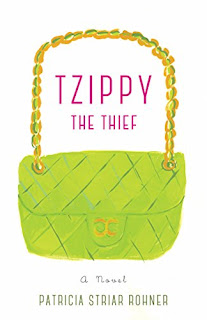
Review: 'Tzippy the Thief' by Patricia Striar Rohner


Tzippy is the story of a vain, self-indulgent, superficial, pampered and narcissistic 80-year-old woman, at the head of a dysfunctional family. She lives in Florida with her live-in, African-American maid. In her latter years, she is in a relationship with Stan, a long-time friend of the family, and especially of her late husband.

This is a well-written and well-edited story. The prose is crisp and concise. Scenes are created vividly, but with a minimum of excess. At times the writing has an almost journalistic feel. Even during Tzippy’s periods of introspection the author refrains from hyperbole and excess. Nevertheless, Tzippy’s feelings, thoughts and worldview are perfectly apparent to the reader. Only in Chapter 18 did I feel that the writing faltered a little, becoming somewhat stilted and hurried.

In the course of the narrative, various of her children—Shari, Bruce and Naomi—and their spouses and partners come on stage, but the main thread concerns Tzippy’s relationship with her younger daughter, Shari, forty-something and an alcoholic. In her younger days—and perhaps still—Shari suffered from anorexia-bulimia. It becomes Tzippy’s late-life crusade to do what she can to heal this relationship and repair some of the harm she has done to the daughter.

Tzippy also has to face two other issues in her life. She is addicted to benzodiazepines, although she does not at first acknowledge this. The author walks a fine line here, and some readers might think that she overplays the irony as Tzippy reflects upon her daughter’s excessive alcohol consumption, while at the same time popping another pill.

The other issue Tzippy has to deal with is her proneness to theft. She is caught on this occasion and has to deal with the humiliation. At the same time her maid of many years—Angie—is caught stealing money from Tzippy. Again, the irony may be a little overplayed; but, again, it is a fine Iine.

The narrative is related exclusively from the intimate, third-person point of view of Tzippy. She is very much centre stage. This lends her an almost celebrity status: she is very much the star of her life, and of the scenes that play out. This is true even when she seems to be focused on the well-being of others. No matter how much she tries to reach out to others, somehow the story is always still about her. There is a tension here, because it is clear that at times Tzippy really does want to be less selfish and less self-centred; yet, somehow, she is never far from the centre of the narrative, or from her own concerns.

The other characters are mostly well drawn. Shari, the younger daughter, is interesting and complex. Even at her most down and out there is an attractive vulnerability to her. The reader also suspects that she knows very well how to use this to her advantage. She has learned manipulation from a master manipulator. The characterisation of the maid, Angie—an overweight African-American woman with a love for caftans—flirts with caricature, but perhaps just avoids it. Tzippy’s love interest, Stan, seems rather shallow and ineffectual, although I think the author’s intention is to present him as practical, down to earth and balanced. Perhaps he is, but against the bright colours of the other characters, he seems somewhat pale and insipid.

But Tzippy is the centre here. I confess that I found it difficult to like her, as is perhaps evidenced by the opening sentence of this review. I found it difficult to take seriously the problems of this pampered and privileged woman. Nor am I sure whether the author wants us to like her. I did have some sympathy for her. She clearly recognises her own superficiality and selfishness. But I couldn’t help feeling that even this was part of her ‘game’, this need to ‘make things right’ and live a deeper, more satisfying life. I can only echo the words of the judge before whom Tzippy appears following her theft: ‘Mrs. Bryer, go home and stop this nonsense.’ 


Wednesday, June 22, 2016

Political Mandate (or not)

There has been a lot of talk recently in Australia (with a federal election on the way) about the meaning of a political mandate. When a party is elected into power, does that mean it has a mandate, a right, to put into place all the policies which it took with it into the election?

The answer is NO, and the reasons are quite simple.

When I go to the polling booth I have to make a choice between parties which have proposed a whole raft of policies. Some of those policies I will agree with; some I will not. This is true on both sides of politics. If I decide (for example) that Party A’s economic agenda is, on balance, slightly better than that of Party B’s, and I decide to vote for them on that basis, that does not mean that I support all their other policies. I might not agree, for instance, with their policy on the environment or towards asylum seekers. Just because I decide to vote for a party on the basis of one or a few issues this does not mean that I do, or am obliged to, support all their policies. Nor do I believe it gives them an automatic right to implement those policies.

Democracy does not begin at 8 am and end at 6 pm on polling day. Democracy requires that I and every one of us continues to advocate for the things that are important to us. It also demands that the government of the day be perpetually answerable to the people, and not just on one day every three years or so.

Just because I voted for YOU does not mean that I believe in everything you stand for; and I will continue to speak loudly and irritatingly about those things I think you have wrong.

Sunday, April 24, 2016

ANZAC Day

My overseas readers may not know what ANZAC Day is. It has to do with the Gallipoli landing during the First World War. It is a very big day in Australia, and seemingly becoming bigger every year.

It is almost sacrilegious and possibly even considered treasonous to say anything that might be regarded as a criticism of this day. Few in Australia regard Christmas or Easter celebrations with anything approaching religious reverence. ANZAC Day is the only holiday in the Australian calendar that attracts this kind of reverence, from the religious and non-religious alike.

I write the next paragraph with some hesitation, because I suspect many in Australia might find its fairly mild wording offensive. Here goes:

‘Today (25 April) marks the anniversary of the attempt, during the First World War, by the allied forces, including Australia, to invade that well-known enemy of Australia, Turkey. The attempt was ill-conceived and disastrous. Unsurprisingly, the Turks vigorously (and successfully) defended their territory. In Australia we commemorate this event as ANZAC Day. I’m not sure how they commemorate it in Turkey.’

Whatever is going on around ANZAC Day in Australia is a little strange and perhaps also a little frightening. Whatever it is, ANZAC Day is not simply a day when we commemorate and honour those whose lives have been lost in war. We have Remembrance Day—or perhaps you know it as ‘Armistice Day’: November 11—to do that. At least that marks the end of the First World War: a suitable time, one would think, to remember the cost of war. ANZAC Day commemorates an attempt to invade another country for strategic purposes: to control the Dardanelles, a strait providing a sea route to the Russian Empire. It is, of course, tragic that so many people lost their lives in that pointless exercise. The Turks who lost their lives during that campaign (does anyone know how many?) were defending their territory. The Australians who tragically died were not defending Australia—despite the propaganda that surrounds ANZAC Day. Unless, of course, you subscribe to the dictum that attack is the best form of defence: easily used to justify any form of aggression.

I am all in favour of remembering the horrors of war, and commemorating the tragic and often pointless loss of life. Remembrance Day is a perfect time to do that. I am less comfortable with the mythology that continues to build around the commemoration of ANZAC Day. I in no way want to belittle the price men paid at Gallipoli—allied troops and Turks alike. But it is a stretch to claim that the Australians (at least) gave their lives in defence of Australia. It’s sad but true—and no fault of theirs—that they gave their lives in a much less worthy cause.

Tuesday, April 19, 2016

'Naturalistic' Dialogue

We writers often try to write dialogue in what we regard as a naturalistic style, but this can be fraught with difficulties. The result may not be what we intended.

We know that the spoken word is very different from the written word. We rarely speak in nice, complete, neat, grammatically correct sentences. Our speech stops and starts; words slide together; we leave the beginnings and endings off words; we pronounce words in particular ways; we change direction in mid sentence. It is the ‘words slide together; we leave the beginnings and endings off words; we pronounce words in particular ways’ that causes the difficulties.

The problem with depicting a character as speaking in a particular accent is that we all have accents, although we seldom realise it of ourselves. If we choose to represent the speech of (say) our Scottish or Irish characters in a particular way, why don’t we do so for all the other characters? The result is usually somewhat clichéd, and some of the characters verge on becoming caricatures. If we wish to represent a character as being less well educated—for example by dropping Hs or leaving the ends off words—we are being unfair to them, because we probably also do that ourselves!

Consider this sentence: ‘Are you going to eat that or not?’ Now say it out loud. How many of you said ‘you’ and ‘going to’? I imagine most of us (brilliantly well educated or not) said something like: ‘Are y’ gonna eat that or not?’ I suggest that when we write a sentence of dialogue, we can assume that the reader will ‘hear’ the latter (or something like it) without our having to spell it out. When it is spelled out it can become difficult to read (and downright annoying). It is also incredibly difficult to maintain such patterns consistently. If I write: ‘Whad’re y’ havin’ f’ dinna’, am I going to do this every time the character speaks? When I as an editor come across something like this, should I be going through and removing the Gs off the end of all this character’s words, because I can guarantee there will be plenty of them. It is as much a nightmare trying to edit this into some kind of consistency as it is to write it consistently in the first place.

Then there is the question of how you actually represent these sounds. Short of using formal phonetic notation, it is very difficult to properly represent pronunciation. Consider this sentence which I came across recently: ‘I do luv a good soup.’ Why ‘luv’ rather than ‘love’? How am I meant to pronounce it? Is the vowel sound the same as in ‘put’ or ‘cup’? These are different sounds in my particular accent. The vowel sound in ‘cup’ (for me) is identical to that in ‘love’. On the other hand, ‘put’ is a different sound from ‘putt’ (which, for me, is like ‘love’ and ‘cup’). So ‘luv’ is unhelpful. How I hear it will depend on where I come from, which is the same for ‘love’ in any case, so why bother spelling it differently? My mother, for instance, in her Birmingham accent, will say ‘love’ as if the vowel is the same as in ‘put’ rather than ‘putt’, but as far as she is concerned she is saying ‘love’ as it is meant to be said, and who am I to tell her otherwise?

Note that an accent is different from dialect. A dialect uses different words, rather than just pronouncing the same word differently. If you can use authentic dialect (and not just what outsiders often wrongly consider to be authentic dialect) that is great.

I always think that a better way to alert the reader to a particular speech pattern is to point it out in the narrative: ‘I struggled to understand his strong Scouse accent’ (for example). ‘Fred always misplaced his Hs when he was speaking.’ Then you don’t have to write it all the time. The reader will hear it. If the reader doesn’t know what a Scouse accent (Liverpool) sounds like, nothing you write on the page will help!

I would never say never write out these ‘naturalistic’ passages of dialogue. On occasion it might be helpful if you want to create a particular effect. But if you do, do so sparingly and with great care. Ask yourself: Will this sound to the reader the way I want it to sound? To some it will; to others it won’t.


Monday, January 11, 2016

David Bowie and me

I know. I suppose everyone will want to have their say about David Bowie, which goes to show what an important influence he has been.

The very first song I heard by David Bowie on Australian radio, and the first to which I attached his name, was ‘Queen Bitch’, from the ‘Hunky Dory’ album. A song with the words ‘queen’ and ‘bitch’ in the title? Would that get airplay in the US even today?

Oh yeah
I’m up on the eleventh floor and I’m watching the cruisers below
He’s down on the street and he’s trying hard to pull sister Flo
Oh, my heart’s in the basement, my weekend’s at an all-time low
’Cause she’s hoping to score, so I can’t see her letting him go
Walk out of her heart, walk out of her mind, oh not her

She’s so swishy in her satin and tat
In her frock coat and bipperty-bopperty hat
Oh God, I could do better than that

She’s an old-time ambassador of sweet-talking, night-walking games
And she’s known in the darkest clubs for pushing ahead of the dames
If she says she can do it, then she can do it, she don’t make false claims
But she’s a queen and such are queens that your laughter is sucked in their brains
Now she’s leading him on, and she’ll lay him right down
Yes, she’s leading him on, and she’ll lay him right down
But it could have been me, yes, it could have been me
Why didn’t I say, why didn’t I say, no, no, no

She’s so swishy in her satin and tat
In her frock coat and bipperty-bopperty hat
Oh God, I could do better than that

So I lay down a while and I gaze at my hotel wall
Oh, the cot is so cold it don’t feel like no bed at all
Yeah, I lay down a while and I look at my hotel wall
And he’s down on the street, so I throw both his bags down the hall
And I’m phoning a cab ’cause my stomach feels small
There’s a taste in my mouth and it’s no taste at all
It could have been me, oh yeah it could have been me
Why didn’t I say, why didn’t I say, no, no, no

She’s so swishy in her satin and tat
In her frock coat and bipperty-bopperty hat
Oh God, I could do better than that

You betcha
Oh, yeah
Uh-huh

What the hell was this song about? It was 1972, I was fifteen years old and I didn’t have a clue. But I knew that it was in some way subversive, and I was hooked. Here was my Elvis, my Beatles or my Rolling Stones: someone my parents would hate.

I was (as usual) a bit behind the times. There were other songs—‘Changes’, ‘Starman’, ‘Ziggy Stardust’, ‘Space Oddity’—that other people apparently already knew. I was a nerdy, fifteen-year-old sci-fi geek, and here was the stranger in a strange land himself; here was the real Valentine Michael Smith. Those weirdly alien-sounding vocals, the bizarre haircut and make-up, the outrageous costumes. ‘The Rise and Fall of Ziggy Stardust and the Spiders from Mars’. It was all there. ‘Ziggy Stardust’ remains—and I don’t think this will be widely disputed—one of the greatest albums of all times.

Over the years David Bowie continued to evolve and experiment, to excite, baffle and disappoint his fans. I suspect all those who count David Bowie among their favourite recording artists will have their favourite era. This will probably be the era in which they first discovered him. He continued to re-invent himself, never content with the success of the past, never content just to repeat himself, never content to simply please his existing fan base. I always wanted everything David Bowie did to be touched with genius, but not all of it was, of course. I hate some of what he did. But he never gave up. He kept coming back. The ‘plastic soul’ era; the Berlin era; the ‘Metal Machine’ era; the ‘Scary Monsters’ era; the ‘new wave/pop’ era. I didn’t like everything he did; but someone else always did.

Then, later in life, in 2002, he surprised me with what I think is one of his best albums, ‘Heathen’. The next two were not so much to my taste. And the latest, ‘Blackstar’, released on his sixty-ninth birthday, just a couple of days before his death? Weird, certainly. I may hate it. I’m not sure. But, once again, he was David Bowie being out there, very much a stranger in a strange land.

There is, of course, much more to David Bowie’s life and career: his collaborations, his movies, his artwork, his internet savviness. He was always the consummate market expert, even down to the timing of his death. Love it or hate it, ‘Blackstar’ is almost guaranteed to become a classic.

David Bowie was my voice in the early years of the nineteen seventies. He expressed for me all the weirdness I was too timid to express myself. Over the years, even during those eras when I didn’t particularly like his work, he was never far from my thoughts. I always had an eye out for news about him. He has accompanied me through life since I was fifteen years old. He is the ultimate icon for my generation. The deaths of very few celebrities have moved me personally. The death of David Bowie has. I feel I have lost a friend and companion this day.

Sunday, January 10, 2016

Hemingway, the App

Every now and then a new application pops up that will claim to make you a better writer, or that will offer to edit your work for you. Of course, MS Word itself offers to do some of this, with its spell checker and grammar checker, and I think we all know that the results are chequered at best.

I came across an app recently: the ‘Hemingway App.’ It claims ‘to make your writing bold and clear’. It does this by pointing out what sentences it considers hard to read or very hard to read; phrases that have simpler alternatives; the number of adverbs (of which it will specify what it considers to be a suitable number for a piece of writing of that length); and uses of the passive voice. It is called the ‘Hemingway App’ because Hemingway is so often held up as a writer whose writing is ‘bold and clear’, a paragon for all writers since. He is often cited by those whose aim is the extinction of adverbs. Once you begin to look more closely at Hemingway’s writing, of course, it becomes clear this his writing is far from always ‘bold and clear’; nor does he particularly shy away from the use of adverbs.

Any piece of software like this is just begging to be put to the test, and this can be done on their web site here: http://www.hemingwayapp.com. Text can be entered and subjected to scrutiny. Naturally, the first author anyone is going to subject to this analysis will be Hemingway himself. Here is the opening paragraph of For Whom the Bell Tolls:

He lay flat on the brown, pine-needled floor of the forest, his chin on his folded arms, and high overhead the wind blew in the tops of the pine trees. The mountainside sloped gently where he lay; but below it was steep and he could see the dark of the oiled road winding through the pass. There was a stream alongside the road and far down the pass he saw a mill beside the stream and the falling water of the dam, white in the summer sunlight.

The first thing the app does is identify three out of four sentences as ‘hard to read’. Erm, well … Either the software can’t count or it is not able to identify sentences very well. There are only three sentences here. Perhaps the app doesn’t know what semi-colons are. Nevertheless, it highlights the whole passage as ‘hard to read’. Hard for whom, one wonders. It identifies ‘gently’ as an adverb and advises its removal. Really? ‘The mountainside sloped where he lay’ would be an improvement? What mountainside doesn’t slope? So, remove an adverb and generate a tautology. The point is that it slopes gently here and not precipitously. The app apparently has no problem with this sentence opener: ‘There was a stream alongside the road …’ I would consider this passive, but the app doesn’t. As an editor I would change this to: ‘A stream ran alongside the road …’ So … not a great start for the app.

It rated this passage a ‘ten’ (good). The lower the rating, the higher the readability, apparently. It goes up to twenty-four. Even the lowest rating of ‘one’, however, is still only ‘good’.

Here’s a passage from a Hemingway short story:

I guess looking at it now my old man was cut out for a fat guy, one of those regular little roly fat guys you see around, but he sure never got that way, except a little toward the last, and then it wasn’t his fault, he was riding over the jumps only and he could afford to carry plenty of weight then. I remember the way he’d pull on a rubber shirt over a couple of jerseys and a big sweat shirt over that, and get me to run with him in the forenoon in the hot sun. He’d have, maybe, taken a trial trip with one of Razzo’s skins early in the morning after just getting in from Torino at four o’clock in the morning and beating it out to the stables in a cab and then with the dew all over everything and the sun just starting to get going, I’d help him pull off his boots and he’d get into a pair of sneakers and all these sweaters and we’d start out.

The app gave this a grade of twenty (poor). That it may be—we are harsh critics—but the point of including it here is to consider adverbs more closely. I have highlighted the adverbs; I see ten of them. The app identified one: roly. Which, of course, isn’t an adverb. (Is it even a word without its ‘poly’ partner?) So … the software doesn’t appear to know what an adverb is.

Finally, who could resist entering some gibberish.

Me thinks this um piece of software is crap. But it likum this. Car happy not today. Me good writer ugh.

This (apparently) is a Grade 1 (but still only ‘good’) piece of writing, with no issues at all. Now I understand what I have been doing wrong.

Some might advise caution when using, or even considering purchasing, the Hemingway App. I would never do that, of course. 

[By the way, this post rated ‘seven’. I’m not at all sure that I should be happy about that!]

Tuesday, December 29, 2015

Review: 'A Yellow-Winged Stranger' by Imran Usman

This is an interesting book and worth persisting with, despite the flaws that I will mention in a moment. It is difficult to allocate it to a genre. I suppose it fits into the ‘literary fiction’ catchall, but that doesn’t say much. There is almost an air of magical realism about the book. I say ‘almost’, because the elements that contribute to this impression turn out to have a logical explanation: for example, a prisoner finding writing upon the wall of a prison cell that relates directly to his own life. For a moment the laws of nature appear fragile. Almost.

The story begins with a family situation, Howard and his parents, which ends with a death. This then segues into the trial of a young man, Ethan, for murder; he is suspected of being a notorious serial killer. The connection between these two parts of the story is not immediately obvious. This then segues into the story of Jack, which is written by Jack himself on the walls of Ethan’s cell. This, then, becomes a first person narrative, whereas the surrounding story is in the third person. Again, the connection of this story with the other stories is not immediately apparent, but gradually emerges. This is a very successful and clever device, despite the apparent implausibility. Then the different strands of the story begin to interact and are skilfully woven together. Even minor characters in the story—a lawyer, a policeman, a forensic investigator—find their place in the back story that emerges.

This is cleverly done, and I think it works, although I did at times find myself a little confused, wondering if the ‘Matt’ (for example) mentioned at this part of the story was the same as the ‘Matt’ mentioned earlier. I think I had it sorted in the end, although one or two nagging doubts about who was who, when and where, remained.

The characters are well drawn and complex. I particularly liked the character of Jack, whose story is written on the cell wall. I am not always a fan of first person narration, but I think this works particularly well. The writing of this particular stream of the narrative was also of a higher quality.

This brings me to the major flaws of the book. In many places the English is very poor. There is poor grammar and incorrect word choice. I imagine that English is not the author’s first language. Several times, particularly early on, I almost gave up on the book because of this, although I am glad that I didn’t. The language at times is excessively flowery, and the characters and narrator are sometimes prone to lapsing into philosophical discourses. This may work well with an Indian audience (the author was born in India) but less so with a Western audience. Although there are still flaws in the ‘Jack’ narrative, I thought the writing was of a higher quality, at times even acquiring a certain beauty.

Many will be put off by the flaws in the writing, or will not have the patience to wait for the strands of the story to be woven together; but those who persist to the end will, I think, be pleased with the result.

I have decided to no longer rate books using the star system. I don't think it is helpful.


Thursday, December 17, 2015

When World Views Clash (and when don’t they?)

The former prime minister of Australia, Tony Abbott, recently stated in an article in an Australia newspaper: ‘Cultures are not all equal. We should be ready to proclaim the clear superiority of our culture to one that justifies killing people in the name of God.’

Where to begin with the issues raised by a comment like this?

First of all, I want to make some obvious points, which nevertheless are rarely made. What we believe, we believe to be true. A tautology? Possibly. The point is that we believe ‘facts’, accept ideas, adopt values because we think they reflect reality at one level or another. Our world view is precisely that, an understanding of the world, because we think—at least at some level—that the world is really like that. (It is tempting to put so many of these words in quotation marks, because their meaning is so slippery and elusive.) We may not always be fully conscious or aware of our own basic world view, but it is there if we dig deeply enough.

So, if I believe that the world is created by a supreme, divine being who has some purpose for this world and for me personally, it is an inevitable corollary of this that I think those who don’t believe in such a being are mistaken. Their view of the world is inaccurate, inappropriate—in some way ‘inferior’ to mine—if the superiority of a belief system is measured in terms of how accurately it reflects ‘reality’. (Here come those damn quotation marks again!)

If we hold to a particular view of the world (and who doesn’t?) it is, therefore, somewhat disingenuous to claim, for example, that all belief systems are ‘equally valid’. It is, of course, entirely possible to hold such a view, but it must, paradoxically, exclude those belief systems (most of them, I suspect) which don’t share it. We may acknowledge someone’s right to hold a view that is different to our own, but we nevertheless believe our own world view to be correct. At least provisionally correct; the best we can do at the moment. There remains here, at least, the acknowledgement that no world view is actually complete or perfect; that additional information may require us to modify that point of view; and that perhaps, on some issues at least, the jury is currently out. The more one is convinced of the truth (read ‘superiority’) of our own world view—some might say, the stronger our ‘faith’—the less room there is for such tolerance, ambiguity and uncertainty.

The second point I want to make I will pose as a question: what criteria can we use to evaluate a culture or world view? The difficulty here is that we can only do so from within our own. I know of no way to elevate ourselves above all cultures and adopt some entirely objective perspective. Consider the points I made in the previous paragraph. They reflect my world view. I believe that a certain humility vis à vis questions of truth is a good thing. I believe that some ambiguity and uncertainty about the nature of reality is inevitable. This is not true of all things. Some issues I believe to be settled. For me, the jury is not out on everything. With respect to those things about which my mind is firmly made up, I will be less tolerant of divergent opinions. I will acknowledge a person’s right to a different point of view, which is actually code for acknowledging their right to be wrong. But this acceptance of ambiguity and this (limited) tolerance of other points of view are not shared by everyone. There are plenty of belief systems in which doubt is anathema, in which truth is absolute and unambiguous. People hold to those views as firmly as I hold to mine, probably more so. Am I right, or are they right? Of course I think I am right. But is there some higher, objective position from which I can claim this with certainty? I don’t believe so. They probably do, and they call it god (by whatever name). So even the question of whether there is some higher, more objective perspective from which to determine ‘truth’ may or may not constitute part of someone’s world view. Herein lies the path to infinite regress.

I heard the new Canadian Prime Minister Justin Trudeau say the other day, with regard to diversity: ‘The elements on which we are similar are far greater than the elements on which we are diverse.’ I don’t doubt that this is true, in simple, quantitative terms. Nevertheless, it is always the differences that loom largest in our minds. We may agree about 99% of things, but it is the 1% about which we disagree that occupies our time and attention. Qualitatively, the one per cent comes to matter much more than the ninety-nine per cent. Is this something deeply ingrained in our psyche over the course of evolution? After all, it is precisely the differences between organisms that drive the process of evolution. Psychologically, I think it is very difficult to focus on the ninety-nine per cent and not be constantly drawn back to the one percent.

I always fall back on this position: while I cannot give definitive answers to questions such as these, I think it is important that they be raised. We need to bring questions like these to the forefront of our minds whenever we are considering the important issues with which the current social and political state of the world confronts us. We need to be aware of our own world view and its limitations. We need to acknowledge our own areas of doubt and uncertainty. At the same time, we need to be aware of the issues that are, in our mind, unambiguous and non-negotiable. We need to be aware of what constitute, for us, absolutes, while at the same time acknowledging our inability to justify their absolute status. In doing this we acknowledge the limits of our certitude without necessarily abandoning it. We need to be aware that we cannot transcend our own perspective. No matter how many steps we take along the infinite regress towards objectivity, we always remain securely ensconced within our own limited point of view.

Life is always much simpler for those who live in certainty and are guided by absolutes. Unfortunately, the world is also made more dangerous by them. As long as they live exclusively within a culture which shares their world view—they imagine such exists—everything is just peachy. When they come up against a world view that is different from theirs, war is inevitable.

If for no other reason than that it may help to avoid war and promote the survival of our species, I will advocate for uncertainty and ambiguity every time. This means, of course, that uncertainty and ambiguity are among my absolute non-negotiables. What happens when my belief system clashes with one in which these very things are totally anathema? Let’s just say that I wouldn’t want to be at a dinner party with Tony Abbott and Abu Bakr al-Baghdadi. At such a dinner party they might find themselves surprising allies against me.